

In this article, we discuss the implications of the pending AI Revolution for organizations and the people who work in them. From BIP Capital’s perspective, the competitive reality of AI adoption is stark: companies that fail to embrace AI will almost certainly face sharply deteriorating financial performance, diminished equity value, and – in many cases – risk extinction. The inability to automate and innovate at pace will leave these organizations trailing, struggling with escalating costs, sluggish growth, and a loss of relevance as the industry landscape rapidly advances. In contrast, firms that adopt an AI-Forward approach may survive and compete, but they are entering a market that is only becoming more fiercely competitive. AI adoption does not guarantee success; it merely ensures companies remain contenders in a marketplace where the bar for performance and innovation is relentlessly rising.
As AI increasingly automates tasks and augments human capabilities, business leaders must:
- Understand the rapidly evolving capabilities (and limitations) of Artificial Intelligence to understand opportunities and threats,
- Redesign how jobs and related tasks get done,
- Redistribute human and machine roles as technology creates new possibilities, and
- Reimagine how AI can create opportunities to expand value propositions.
Indeed, the manager of the future will need to manage both people and AI agents.
The article seeks to establish foundational models that will guide stakeholders in navigating the changing landscape. These models will help clarify how organizational design, talent allocation, and leadership strategies must adapt to thrive in an AI-driven future, providing practical insights for those seeking to anticipate and respond to ongoing disruption.
Model 1: The Organizational Design Shift – From Pyramid to Diamond
How AI Workflow Automation is Reshaping Every Level of the Organization
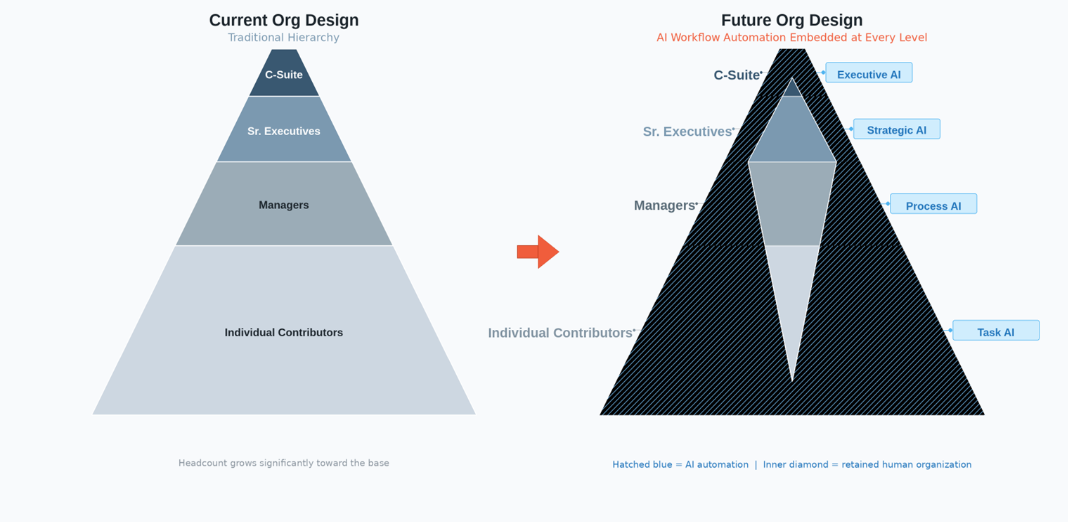

In many organizations (especially in software and professional services), the shift in organizational design from a traditional pyramid to a diamond shape will be fundamentally driven by workflow automation, which replaces many individual contributors performing repetitive tasks. As automation takes over routine activities, the structure of organizations narrows at the bottom of the pyramid, reducing the need for a broad base of entry-level employees and concentrating talent in specialized and managerial roles.
Implications for Different Types of Workers:
Reading straight through? Get the full piece and access to the full Future of Organizations series. Access the full article.
C-SUITE EXECUTIVES
For the C-suite, this means:
- Adopting an AI-first mindset for the organizations they lead.
- Enabling learning and rapid skill development for their organizations in the area of Artificial Intelligence.
- Prioritizing organizational agility and innovation, as technology enables faster decision-making, greater operational visibility, and increased potential for efficiency.
- Adapting their strategies to leverage data-driven insights, while managers become orchestrators of hybrid teams composed of both humans and machines.
- Monitoring and analyzing considerably more data to make timely, accurate strategic decisions.
SENIOR EXECUTIVES
For Senior Executives, this means:
- Embracing an AI-first mindset for the functions they lead.
- Using automation to orchestrate rapid strategy development.
- Using automation to create faster feedback loops.
- Using decision intelligence to analyze and enable rapid understanding of emerging business trends and leading KPIs.
- Leveraging decision intelligence to aid rapid decision-making and strategic responses.
- Using AI as a tool to educate functional teams to be best in class strategically and operationally.
MANAGERS
For Managers, this means:
- Reskilling and developing a strong understanding of AI capabilities to effectively guide their teams in this rapidly evolving landscape.
- Streamlining scheduling, project management, reporting, and other “automate-able” tasks
- Constantly rethinking the deployment of human resources and AI resources.
- Being highly proficient in managing an array of human beings and a large array of AI agents.
- Developing new agents to drive continued workflow automation, data capture, and increased ability to leverage decision intelligence.
INDIVIDUAL CONTRIBUTORS
For Individual Contributors, this means:
- Refocusing their time on high-judgment work – problem-solving, creativity, and decision support – while task-oriented execution is automated.
- Recommending and developing agents of their own to accelerate automation.
- Reskilling and developing a strong understanding of AI capabilities to effectively increase their efficiency and impact on the organization.
- Working alongside agents when workflows and tasks are partially automated.
- Applying context to support AI where automation creates ambiguity, risk, exceptions, or incomplete answers.
If individual contributors are to obtain consistent employment in the AI Economy, they will need to demonstrate unique skills that complement automated systems.
STRATEGIC CAUTION: It is important not to assume that cost reduction is the only, or even the primary, benefit for organizations adopting an AI-First or AI-Native approach. In many businesses, the most significant advantage will be the effectiveness of labor redeployment, as illustrated in Model 4 (shown below), which enables companies to unlock new value and drive innovation.