


The company's structure is changing now. Company financials have not caught up, and the gains that do arrive may not last.
How is AI changing the structure of private companies?
For most of the past century, knowledge-work companies were built as pyramids: a broad base of entry-level staff doing routine work, a middle layer of managers, and a narrow top. Mark Buffington’s Future of Organizations series at BIP Capital argues that AI workflow automation narrows the base of that pyramid because the routine tasks once assigned to junior staff are the tasks AI absorbs most readily. The result is a diamond: fewer people at the bottom and more of the organization concentrated in the middle.
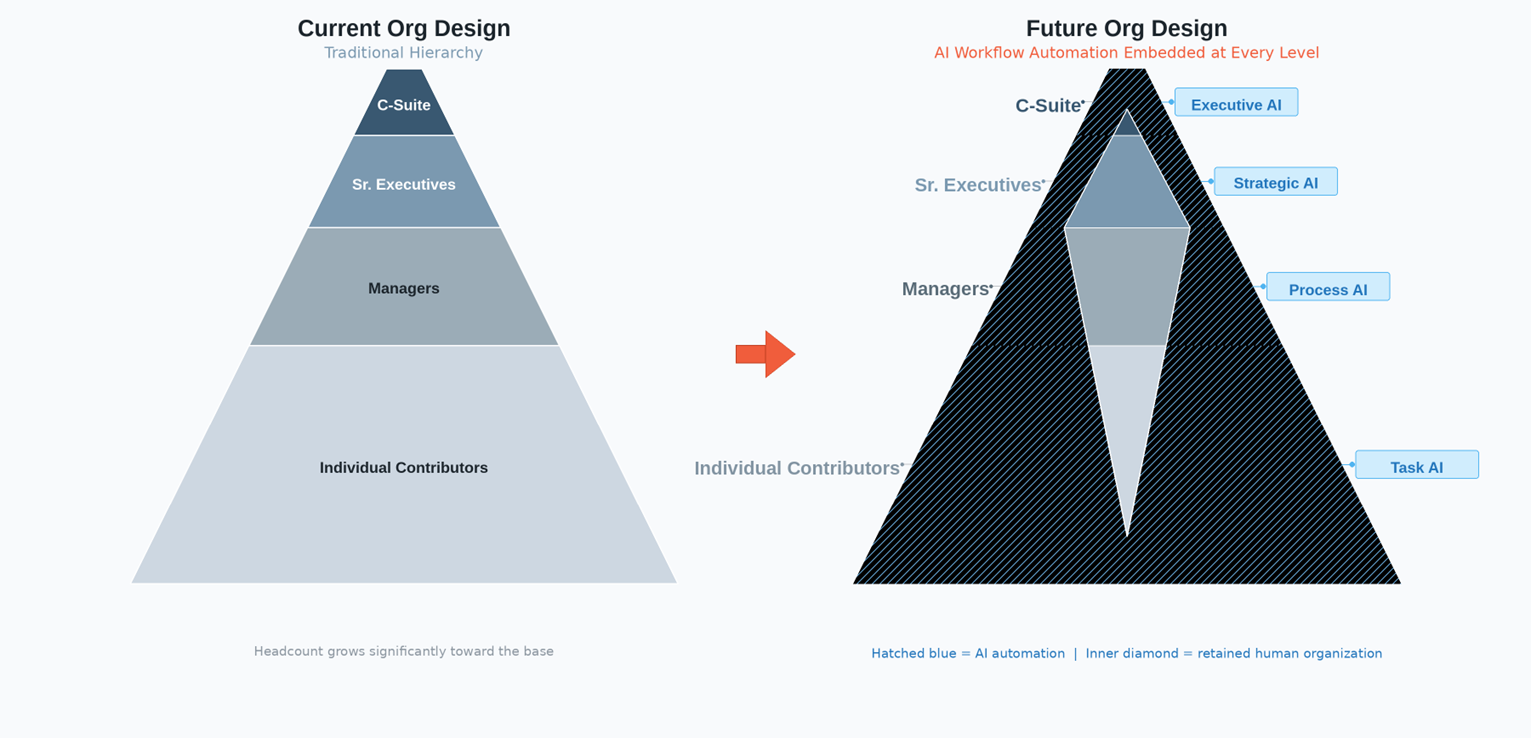
Figure 1. The organizational design shift from pyramid to diamond. Graphic: Property of BIP Capital, LLC. All rights reserved. Source: The Future of Organizations, Article 2. The model shows the retained organization widest at the manager layer; the evidence discussed below points instead to experienced individual specialists, with managers overseeing larger teams.
The base is narrowing in the data. Brynjolfsson, Chandar, and Chen of the Stanford Digital Economy Lab, using ADP payroll records, found in their August 2026 revision that employment among 22–25-year-olds in the two most AI-exposed occupation groups fell about 11% between November 2022 and June 2026, while the same age group in less-exposed occupations grew about 10%. The authors describe the findings as descriptive patterns rather than causal estimates. SignalFire reports that new-graduate hiring at 12 large technology companies is about 65% below 2019 levels and about 76% below at early-stage startups, although that decline began with the 2023 rise in interest rates. The Federal Reserve Bank of New York reports unemployment for recent college graduates at about 5.6% and underemployment at 42%.
The middle of the diamond is forming differently than the series expected. The original framework placed the expanded middle in specialized and managerial roles. The evidence points more toward experienced individual specialists, with managers overseeing larger teams. SignalFire found that engineering managers at large technology companies now oversee about 12 engineers, up from 10, and about 15 at startups. For a private company, that means a smaller junior bench, fewer management layers, and a workforce whose cost and value both rest more heavily on experienced staff.
Not every large employer is abandoning its junior bench. On Accenture’s October 1, 2026, earnings call, CEO Julie Sweet said the firm expects to continue hiring in fiscal 2027, though at a lower rate than in 2026, in part because of AI. She also said Accenture still expects to hire more entry-level staff because it is redesigning those roles, and that revenue per person rose over the year, partly due to AI. That pattern is consistent with a narrower base rather than an eliminated one: fewer junior hires overall, doing different work.
Is AI improving company profits yet?
For most companies, the impact is not measurable. McKinsey’s August 2026 survey found that 37% of respondents attributed any EBIT impact to AI, essentially unchanged from the prior year, and that only about 6% qualified as high performers deriving at least 5% of EBIT from AI. A Federal Reserve Bank of Atlanta working paper surveying nearly 6,000 executives across four countries found that more than 80% of firms reported no impact on employment or productivity over the prior three years. In a separate Atlanta Fed survey, US executives attributed a 1.8% labor productivity gain to AI in 2025 and expected 3.0% in 2026.
The strongest causal evidence is also the most restrained. Humlum and Vestergaard, linking surveys of about 25,000 Danish workers to administrative records, found null effects on earnings and recorded hours, ruling out effects larger than 2%. The Yale Budget Lab reported in September 2026 that US labor market data do not yet show clear evidence of AI-driven disruption.
Taken together, the evidence points to a two-speed change. Companies are already reshaping how they hire, while the financial payoff remains concentrated among a small minority of firms. For allocators, the first effect is visible in portfolio companies' headcount plans today; the second will determine which of those companies earn their valuations.
Why does this matter for private market portfolios?
Private company valuations adjust to these shifts with a lag. Bain’s 2026 midyear private equity report, using MSCI data, found that software valuations in buyout portfolios fell about 8% through March 31, 2026, compared with a nearly 30% decline in public software in February 2026. That gap may reflect genuine differences in quality, or it may reflect marks that have not yet caught up. Three questions determine which: whether portfolio companies are converting AI-freed capacity into growth or only into savings, whether their margin gains will survive competition, and which parts of their value proposition AI makes cheaper for everyone.
Should companies redeploy AI-freed capacity or cut costs instead?
When AI absorbs routine tasks, it frees capacity, and management has to decide how to use it. The capacity can be converted into margin through headcount reduction, or it can be redeployed to work that expands what the company delivers: new services, broader customer coverage, and faster product development. The Future of Organizations series frames the redeployed capacity this way:
The direction of the argument has some support; the magnitude does not. McKinsey reports that high performers typically pursue growth or innovation alongside efficiency, and that nearly three-quarters of them redesigned workflows, compared with about one-quarter of other respondents. Employers surveyed for the World Economic Forum’s Future of Jobs Report 2025 said they plan to prioritize upskilling (85%) and to move staff from declining to growing roles (50%), although 40% also plan to reduce headcount where AI can automate tasks. PwC’s 2026 Global AI Jobs Barometer found that the most AI-exposed companies grew headcount by 52% from a 2018 baseline, compared with 36% for the least exposed.
Each of these findings is self-reported or correlational, and most come from firms that sell AI consulting services. None establishes that redeployment leads to better results; companies that are already growing may simply have more room to redeploy. Expectations of cuts are also rising: 39% of McKinsey respondents expect AI-related headcount declines in the coming year, up from 32%. However, prior-year expectations were about double the declines later reported.
Why might AI margin gains not endure?
In the short run, a company that automates ahead of its competitors can lower its costs while keeping prices unchanged. That advantage erodes as competitors adopt the same tools, because customers learn that the work now costs less to produce. Daron Acemoglu’s task-based estimate in Economic Policy puts AI’s contribution to total factor productivity at no more than 0.66% over ten years. If the aggregate gain is modest, most of the advantage any single company captures must come from taking share from rivals, and that advantage is temporary unless something else protects it.
IT services firms are the clearest current example. Infosys stated in its fiscal 2026 Form 20-F that competitors’ AI-driven productivity could lower customers’ total cost of ownership and that “we may have to reduce prices.” Accenture CEO Julie Sweet offered a counterpoint on the firm’s October 1, 2026, earnings call: Accenture is passing more AI productivity to clients and, by her account, more than offsetting it with new kinds of work and broader scope. That is the redeployment argument applied at the vendor level.
Software valuations point the same way. Software Equity Group reports that the median EBITDA for its SaaS index rose about 70% year over year in 2Q26, while the median EV/TTM revenue multiple fell from 5.7x to 3.2x. Fear of AI substitution and interest rates both contributed, so the decline does not prove the thesis, but it shows that the market did not pay more for higher margins on their own.
Which parts of a company’s value proposition does AI make cheaper for everyone?
The Future of Organizations series breaks down a company’s value to customers into components: functional output, outcomes, trust and relationships, speed, risk reduction, information and decision support, network effects, and experience, less the cost and friction the customer bears. AI lowers the cost of producing some of these components far more than others. Functional output and speed are the most exposed because they are what AI tools deliver most directly. McKinsey found that 32% of organizations had decided against buying at least one software product because they could build it internally with AI coding tools.
Trust, proprietary data, network effects, and risk reduction are harder to replicate because they depend on relationships, accumulated history, or accountability that a new tool does not provide. This decomposition is an analytical framework rather than an empirical finding; no study yet measures AI’s effect on each component directly. The series states the implication plainly:
Task-level studies add nuance relevant to the pyramid. Cui and coauthors, in randomized trials covering 4,867 developers at three firms published in Management Science, found a 26% increase in completed tasks, with larger gains among less experienced developers. Brynjolfsson, Li, and Raymond, studying 5,172 customer-support agents in the Quarterly Journal of Economics, found a 15% average productivity gain: less experienced workers improved both speed and quality, while the most experienced saw small gains in speed and small declines in quality. AI makes junior staff more productive and lets senior staff absorb junior tasks, so the same evidence is consistent with both keeping and cutting the entry-level bench.
What are private equity and venture capital managers seeing in their portfolios?
Managers report modest results so far. In the Bain and StepStone 2026 GP Outlook, nearly 40% of general partners said they did not expect a material financial impact from AI in 2026, and portfolio company benefits were skewed toward cost savings. A Bain survey of 100 portfolio company CEOs, published in September 2026, found that 82% said their AI transformation was at best partially realizing its intended results.
The pressure to deliver growth is rising. Bain’s Global Private Equity Report 2026 argues that deals now require faster EBITDA growth because multiple expansion and inexpensive debt have faded. Software valuations continue to reward growth over margin: Software Equity Group’s Rule of 40 analysis weights growth twice as heavily as margin, and companies scoring above 40 traded at a median 12.4x revenue, according to its 2025 annual report.
Venture-backed companies are running leaner. Carta data reported by Yahoo Finance in May 2026 show the average Series D headcount down 29% from its 2023 peak, to 131. Startup headcount peaked before generative AI was widely available, so funding conditions explain part of that decline.
What should advisory firms ask managers regarding AI and portfolio company economics?
The economic questions complement the exposure questions covered in our earlier article, Questions to Ask a Venture or Growth Equity Manager About AI in Their Portfolio. They focus on whether AI is changing the financial trajectory of portfolio companies, not only their risk profile.
Strong answers are specific and company-level, and they distinguish what has been measured from what is expected. A manager who describes AI only as a margin program is highlighting an advantage the evidence suggests will narrow as competitors adopt the same tools.
The structural change is underway and measurable. The financial change is early, uneven, and in some sectors already being competed away. For allocators, the companies most likely to hold their value are those using AI to deliver something customers could not get before.