

Companies will be Redesigned and Reorganized for an AI-Driven Future. This article proposes four basic models for understanding the implications of the rise of Artificial Intelligence.
About this Article
In this article, we discuss the implications of the pending AI Revolution for organizations and the people who work in them. From BIP Capital’s perspective, the competitive reality of AI adoption is stark: companies that fail to embrace AI will almost certainly face sharply deteriorating financial performance, diminished equity value, and – in many cases – risk extinction. The inability to automate and innovate at pace will leave these organizations trailing, struggling with escalating costs, sluggish growth, and a loss of relevance as the industry landscape rapidly advances. In contrast, firms that adopt an AI-Forward approach may survive and compete, but they are entering a market that is only becoming more fiercely competitive. AI adoption does not guarantee success; it merely ensures companies remain contenders in a marketplace where the bar for performance and innovation is relentlessly rising.
As AI increasingly automates tasks and augments human capabilities, business leaders must:
- Understand the rapidly evolving capabilities (and limitations) of Artificial Intelligence to understand opportunities and threats,
- Redesign how jobs and related tasks get done,
- Redistribute human and machine roles as technology creates new possibilities, and
- Reimagine how AI can create opportunities to expand value propositions.
Indeed, the manager of the future will need to manage both peopleand AI agents.
The article seeks to establish foundational models that will guide stakeholders in navigating the changing landscape. These models will help clarify how organizational design, talent allocation, and leadership strategies must adapt to thrive in an AI-driven future, providing practical insights for those seeking to anticipate and respond to ongoing disruption.
Model 1: The Organizational Design Shift – From Pyramid to Diamond
How AI Workflow Automation is Reshaping Every Level of the Organization
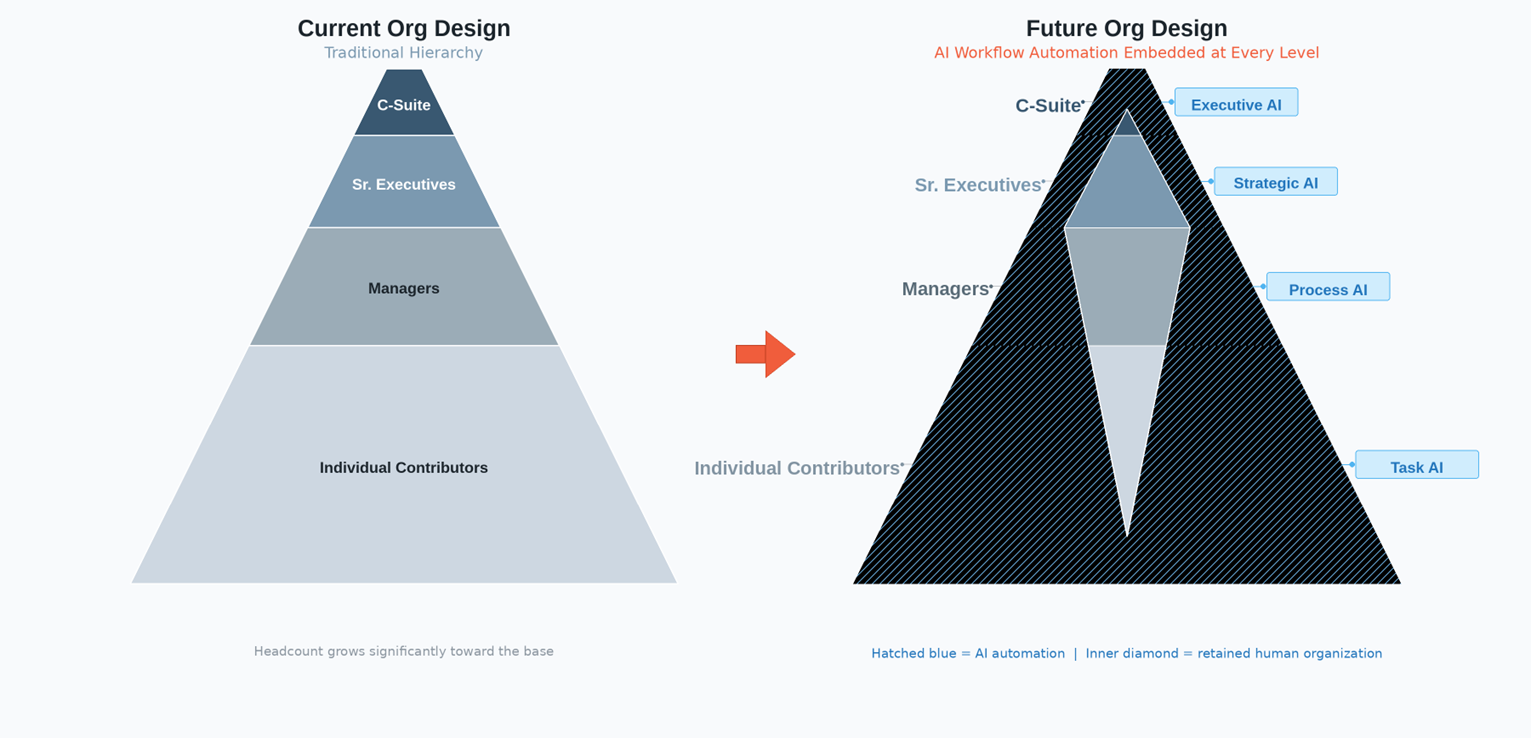
Note: This model assumes that individual contributors and managers are not reassigned to other growth initiatives within the organization, and therefore the work quantity remains constant.
Graphic: Property of BIP Capital, LLC.® All Rights Reserved.
In many organizations (especially in software and professional services), the shift in organizational design from a traditional pyramid to a diamond shape will be fundamentally driven by workflow automation, which replaces many individual contributors performing repetitive tasks. As automation takes over routine activities, the structure of organizations narrows at the bottom of the pyramid, reducing the need for a broad base of entry-level employees and concentrating talent in specialized and managerial roles.
Implications for Different Types of Workers
C-SUITE EXECUTIVES
For the C-suite, this means:
- Adopting an AI-first mindset for the organizations they lead.
- Enabling learning and rapid skill development for their organizations in the area of Artificial Intelligence.
- Prioritizing organizational agility and innovation, as technology enables faster decision-making, greater operational visibility, and increased potential for efficiency.
- Adapting their strategies to leverage data-driven insights, while managers become orchestrators of hybrid teams composed of both humans and machines.
- Monitoring and analyzing considerably more data to make timely, accurate strategic decisions.
SENIOR EXECUTIVES
For Senior Executives, this means:
- Embracing an AI-first mindset for the functions they lead.
- Using automation to orchestrate rapid strategy development.
- Using automation to create faster feedback loops.
- Using decision intelligence to analyze and enable rapid understanding of emerging business trends and leading KPIs.
- Leveraging decision intelligence to aid rapid decision-making and strategic responses.
- Using AI as a tool to educate functional teams to be best in class strategically and operationally.
MANAGERS
For Managers, this means:
- Reskilling and developing a strong understanding of AI capabilities to effectively guide their teams in this rapidly evolving landscape.
- Streamlining scheduling, project management, reporting, and other “automate-able” tasks
- Constantly rethinking the deployment of human resources and AI resources.
- Being highly proficient in managing an array of human beingsand a large array of AI agents.
- Developing new agents to drive continued workflow automation, data capture, and increased ability to leverage decision intelligence.
INDIVIDUAL CONTRIBUTORS
For Individual Contributors, this means:
- Refocusing their time on high-judgment work – problem-solving, creativity, and decision support – while task-oriented execution is automated.
- Recommending and developing agents of their own to accelerate automation.
- Reskilling and developing a strong understanding of AI capabilities to effectively increase their efficiency and impact on the organization.
- Working alongside agents when workflows and tasks are partially automated.
- Applying context to support AI where automation creates ambiguity, risk, exceptions, or incomplete answers.
If individual contributors are to obtain consistent employment in the AI Economy, they will need to demonstrate unique skills that complement automated systems.
Model 2: The Anatomy of a Value Chain
For a Fixed Amount of Work, AI Agents Will Progressively Absorb More Workflow Automation and Decision Intelligence Tasks – Compressing the Human Layer
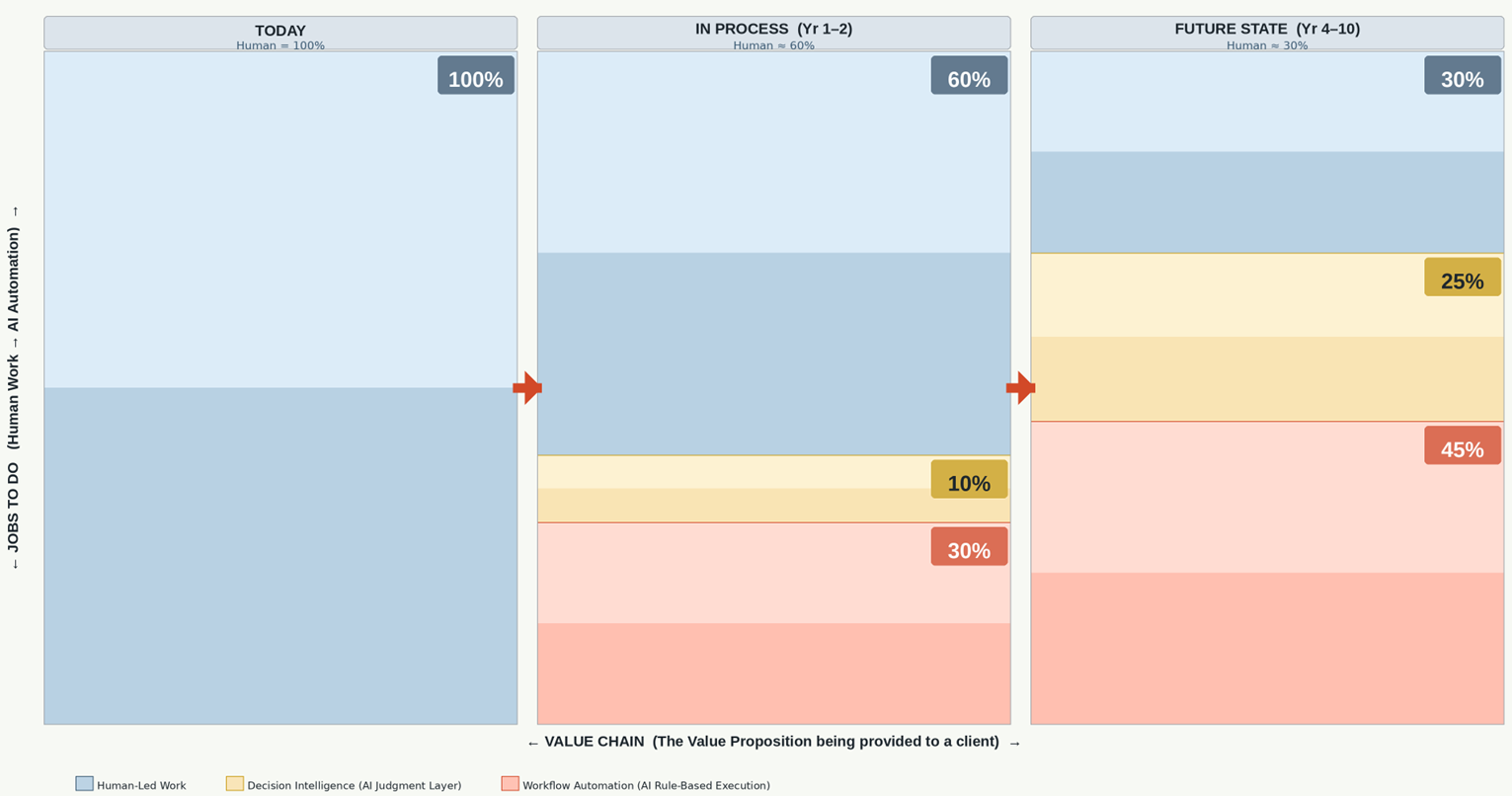
Note: Automation rates will vary by industry and business. This analysis is built for the typical technology-enabled service company. Zone heights represent the approximate share of total work performed by each layer. Human = strategic judgment & relationships. Decision Intelligence = AI handling pattern-based reasoning. Workflow Automation = AI handling rule-based execution.
Graphic: Property of BIP Capital, LLC.® All Rights Reserved.
The graph above is a conceptual outline of a two-dimensional graph illustrating the relationship between a company's value chain (the value it provides to customers) and the taxonomy of tasks required to deliver that value.
- X-Axis (Horizontal): Value Chain — Represents the array of distinct value propositions that a business delivers to its customers, illustrating how each segment of the company contributes to meeting customer needs and creating meaningful outcomes throughout the customer journey.
- Y-Axis (Vertical): Task Taxonomy — Represents the hierarchy of tasks (grouped as jobs) that make up the total jobs required to deliver the value chain, ranging from routine/repetitive tasks at the bottom to complex/creative tasks at the top.
Each point or area on the graph indicates the types of tasks performed within a specific segment of the value chain. This visualization helps identify which tasks are candidates for automation and which require unique human skills, providing insights into how workflow automation impacts both specific roles and the broader organizational structure. It also serves as the key foundation for understanding and assessing the impact of Artificial Intelligence.Throughout this series of articles, we will build on this foundational model, so understanding it will be key to understanding the more advanced models we will introduce in subsequent articles.
Model 3: AI Expands the Value Chain
For a Fixed Amount of Work, AI Expands the Value Chain into New Capabilities Territory
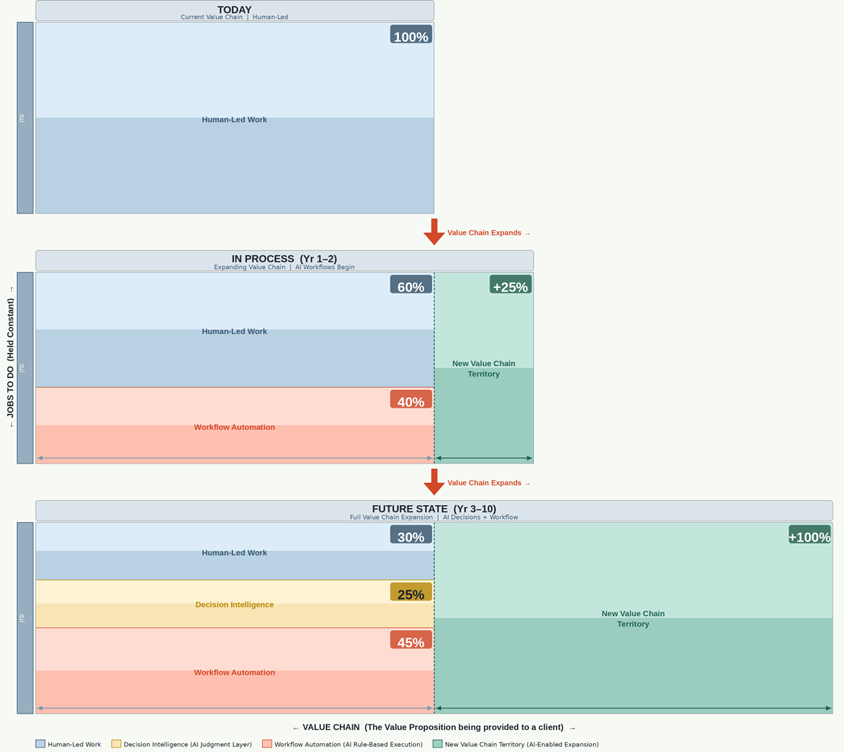
Note: Automation rates and expansion timelines will vary by industry and business. The Jobs To Do (JTD) dimension remains constant — AI does not reduce scope of work; it redistributes how that work is performed and extends the value chain into new territory previously inaccessible without AI-enabled capabilities.
Graphic: Property of BIP Capital, LLC.® All Rights Reserved.
Model 3 describes the point at which AI fundamentally changes the competitive landscape by expanding, rather than just optimizing, the value chain. In this model, AI continues to absorb workflow automation and decision‑intelligence tasks, but the critical shift is that these capabilities unlock entirely new areas of value creation that were previously uneconomical, too complex, or too slow to deliver. Human work does not disappear; instead, it becomes more concentrated in judgment, synthesis, context, and accountability, while machines handle execution and pattern‑based reasoning at scale. The result is not simply a leaner organization, but one capable of delivering more value across a broader surface area.
The most important potential of AI, therefore, is not just its ability to deliver an efficiency boom, but its ability to enable innovative, fast‑acting companies to expand their value proposition and move market boundaries. Organizations that treat AI purely as a cost‑reduction tool will capture only first‑order gains and eventually face commoditization as competitors catch up. In contrast, early movers that use AI to extend their value chain can redefine what the market expects, creating new offerings, faster feedback loops, and structurally superior economics. Over time, this compounds into durable competitive advantage, forcing slower adopters to compete on a shrinking legacy value chain with declining relevance and margin pressure.
Model 4: The Labor Redeployment Model
As AI is absorbed into routine tasks and coordination, freed human labor is redeployed to expand the value proposition and accelerate revenue.
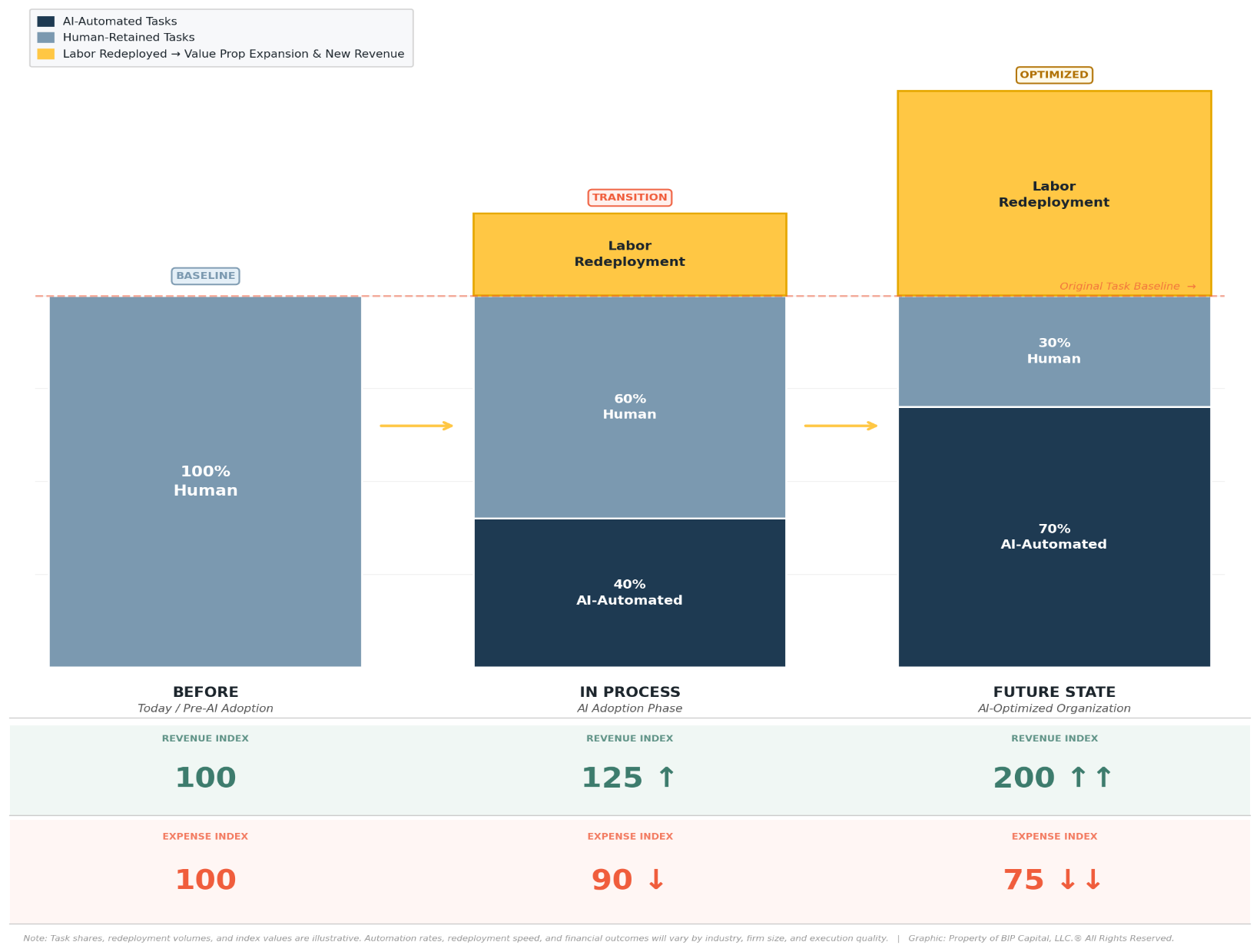
Before: Rev 100 / Exp 100
In Process: Rev 125 / Exp 90
Future State: Rev 200 / Exp 75
The Model
When AI absorbs routine and repetitive tasks, it does not simply reduce workload – it liberates capacity. The Labor Redeployment Model illustrates this progression across three stages: a pre-AI baseline where 100% of tasks are human-executed, a transition phase where 40% of tasks are automated and freed labor begins flowing upward, and a fully optimized state where 70% of original tasks are AI-handled and a substantial block of human effort has been redirected toward value proposition expansion. The critical insight is the yellow zone – the labor that sits above the original task baseline. That is not surplus headcount. That is strategic capital. Organizations that treat it as a cost-saving measure leave the most valuable part of the AI dividend on the table.
The Management Decision
The harder management decision – and the one most organizations are underprepared for – is knowing when to improve margins through workforce reduction versus when to redeploy freed capacity into revenue-generating or value-enhancing activities. Both are legitimate strategies, but they carry fundamentally different risk-return profiles and time horizons. Headcount reduction converts liberated capacity into immediate margin improvement, as seen in the model's Expense Index compression (from 100 to 90 to 75). Redeployment, by contrast, is a bet on growth – it accepts near-term cost in exchange for Revenue Index expansion (from 100 to 125 to 200). The manager who defaults to reduction without asking whether the market opportunity justifies redeployment is optimizing for the wrong objective. The manager who deploys without a clear path to revenue capture is burning cash. The discipline lies in making that decision explicitly, with data, rather than by inertia or instinct.
The Mathematical Framework
To formalize this trade-off, consider a differential equation that models the rate of change of firm value V as a function of two competing uses of liberated labor capacity L. The equation forces managers to make the redeployment decision explicit — assigning each unit of freed capacity to either growth (Lr) or cost reduction (Lc) — and evaluates whether the marginal return on one exceeds the other:

Where
Firm value grows fastest when α · R′(Lr) > β · C′(Lc) — that is, when the marginal return on redeploying one more unit of labor into growth exceeds the marginal return on converting it to savings. When that inequality flips, the balance should tilt toward cost capture.
In practice, most firms should run a portfolio across both Lr and Lc, calibrated to market conditions, competitive timing, and their own execution bandwidth. The equation does not produce a precise forecast – it is a forcing function for an explicit, defensible strategic choice. Managers who run this analysis role by role and function by function will consistently outperform those who apply a blanket policy of either reduction or reinvestment across the board.
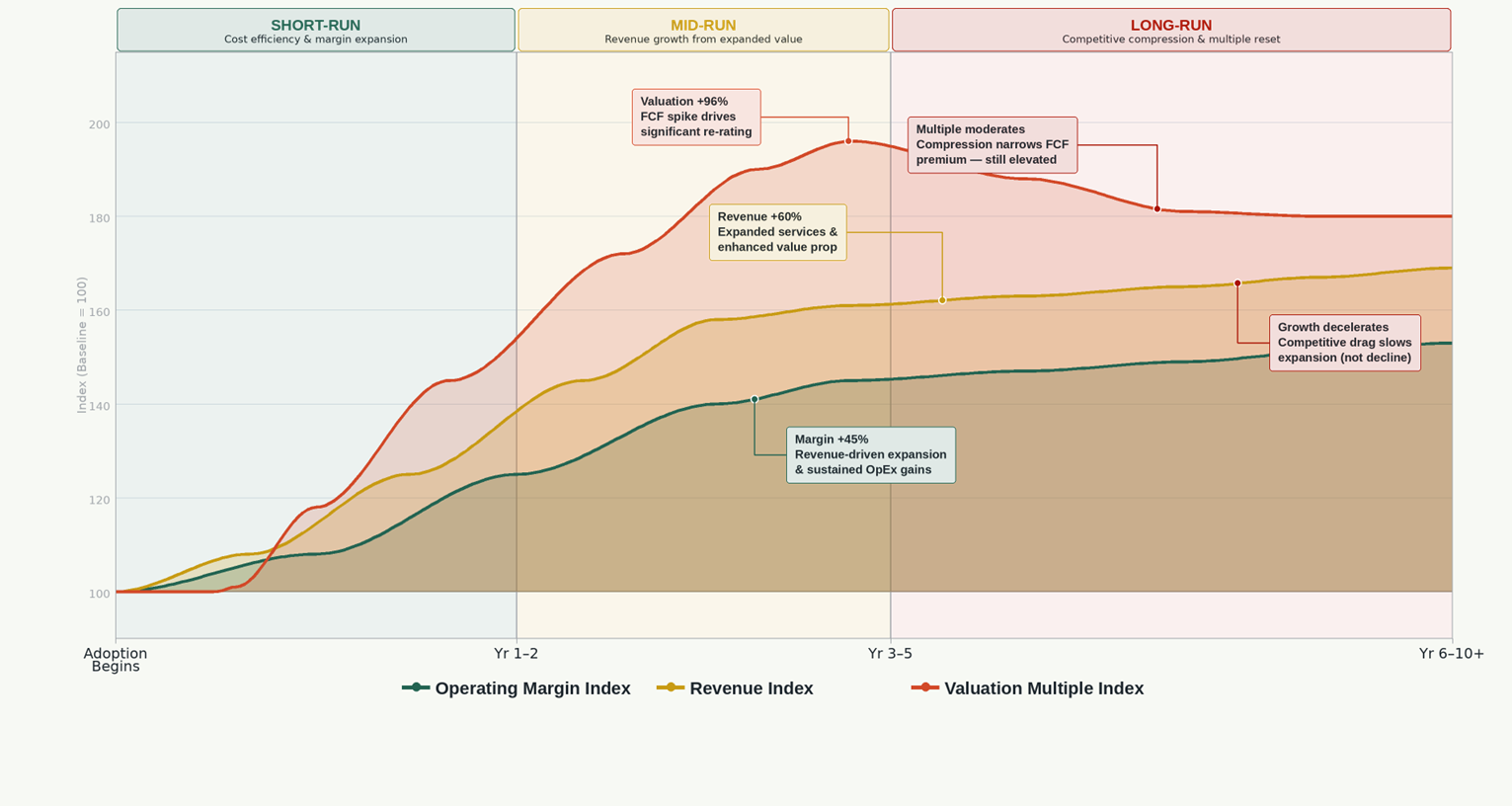
Model 5: 1ST & 2ND Order Economic Effects of Early AI Adoption
How Workflow Automation and Value Prop Enhancements Reshape Margins, Revenue & Valuation Multiples
Graphic: Property of BIP Capital, LLC. ® All Rights Reserved
In the Short-Run
Organizations adopting workflow automation early will see reductions in operating expenses and improvements in profit margins, as efficiency gains translate directly into cost savings. Beyond margin gains, artificial intelligence will also enable organizations to enhance their value proposition, providing near-term growth opportunities and a buffer against revenue compression as lagging firms eventually adopt AI solutions.
In the Long-Run
As competitors automate and operational efficiency becomes the norm, we expect that second-order microeconomic effects will emerge: price competition will intensify, revenue compression will occur, margins will come under pressure, and scale, efficiency, and total value proposition will become critical for firms to maintain market share and demonstrate continued growth. Firms that are able to expand margins and produce consistent growth will see their valuation multiples. This ongoing evolution demands that business leaders, executives, and investors not only embrace automation but also anticipate its broader impact on organizational design and market dynamics.
While the financial metrics that determine a business's long-term value and success – such as revenue growth, revenue stability, operating margins, and other traditional indicators – will remain constant, maintaining strong performance in these areas is set to become significantly more challenging without adopting Artificial Intelligence. Businesses that fail to embrace AI, workflow automation, and human augmentation will find it increasingly difficult to sustain these metrics as competitive pressures intensify. Even organizations that adopt these technologies will face heightened competition, as AI amplifies capabilities and accelerates innovation across nearly every industry. The stakes are rising, and the margin for error is shrinking; in the AI-driven economy, traditional metrics will still matter, but achieving them will require greater adaptability, strategic investment, and continuous reinvention.