

Public equity benchmarks continue to dominate advisor conversations, and the 60/40 portfolio still anchors many financial plans. But the companies generating the most significant value creation over the last two decades did much of that work while still privately held — outside the indexes, outside the benchmarks, and largely outside the average client portfolio.
The 60/40 model, broadly defined as 60% equities and 40% fixed income, was developed during a period when public markets dominated capital formation. Most large companies were publicly listed. Bonds provided reliable income and acted as an effective hedge against equity drawdowns.
This is not a critique of public markets. It is a structural observation about where capital formation has migrated and why advisors who ignore that migration are now managing a portfolio designed for a market structure that has measurably changed.
The Market Financial Advisors Were Trained to Navigate
The modern advisory industry was built around a market structure that looked very different from the one investors face today.
For decades, portfolio construction was shaped by an environment in which public markets represented much of the investable universe. The traditional 60/40 framework emerged during a period when public equities offered broad exposure across sectors, company stages, and economic growth cycles, while fixed income provided meaningful income generation and diversification benefits. In that environment, advisors could build globally diversified portfolios almost entirely through publicly traded securities.
The two-asset-class portfolio was not just convenient; it accurately reflected where wealth was created and where risk could be managed.
That representation is now incomplete. Global private markets’ assets under management exceeded $13.1 trillion as of mid-2023 according to conservative estimates, and continue to expand — a figure that reflects decades of structural migration away from public ownership, not a cycle (McKinsey Global Private Markets Report, 2024). Understanding what drove that migration is essential to understanding why the 60/40 model's limitations are not temporary.
Three Structural Shifts That Changed the Math
1. Companies Stay Private Longer — and Grow More While They Do
The most consequential change for public-market investors is one they cannot observe: the migration of enterprise value creation into private ownership.
In the late 1990s, the median age of a U.S. technology company at IPO was approximately four years. By 2024, companies were going public at an average age of roughly 14 years — a decade later in their development cycle (Jay R. Ritter). That ten-year extension is the period in which most companies move from early commercialization to scaled, mature enterprises. It is the period in which the most significant equity value has historically been created.
The consequence is direct. A growing share of enterprise value is now created before a company enters the public market. An investor in a public equity index is, in many cases, buying a company that has already been through its highest-growth phase as a private entity.
In 1996, there were approximately 8,000 U.S.-listed companies. Today that number is closer to 4,300 — a decline of roughly 46%.
Center for Research in Security Prices (CRSP), 2023; NBER Working Paper No. 21181, via Blue Trust
That reduction in the number of publicly traded companies is not incidental. Fewer listed companies mean fewer opportunities for public-market investors to access diversified equity exposure, and fewer chances to participate in the growth of industries that remain privately capitalized throughout their most productive years.
2. Private Markets Have Grown to Institutional Scale
Over the last two decades, private markets evolved from a relatively specialized institutional allocation into a broad ecosystem encompassing private equity, venture capital, private credit, infrastructure, real assets, secondaries, and structured finance. What matters is not simply the scale of that growth, but what it reflects about how businesses now operate and how sophisticated investors increasingly construct portfolios.
The modern capital formation cycle looks markedly different than it did a generation ago. Companies today can access deep pools of private capital at nearly every stage of growth, often eliminating or significantly delaying the need to enter public markets early in their lifecycle. As a result, a growing share of operational scaling, enterprise value creation, and strategic financing now occurs entirely within private markets. Businesses that once would have gone public at relatively early stages can now remain private for years longer while still accessing institutional-quality capital.
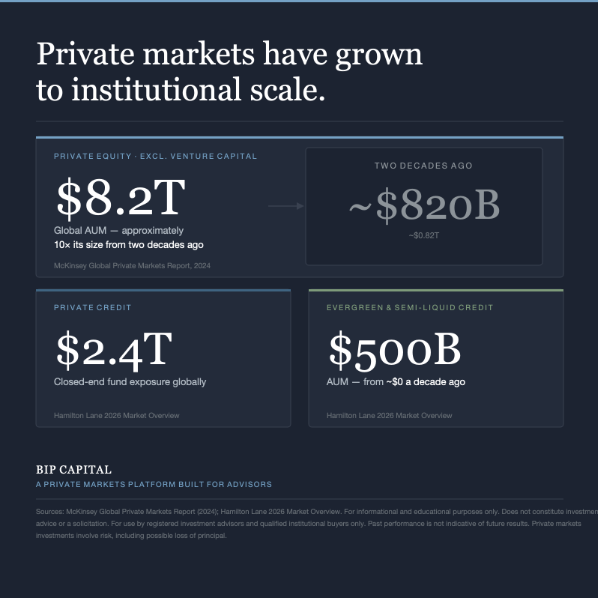
This is not niche capital. This is the core of how businesses are built, financed, and transferred in the modern economy. The firms operating in private markets now include the world’s largest and most sophisticated institutional investors — and that concentration of analytical and operational resources has made private markets increasingly efficient at deploying capital into opportunities that public markets cannot access at the same stage, price, or structure.
3. The Institutional Allocation Gap Is Closing
Institutional investors did not move meaningfully into private markets because of trend-following or product innovation. They did so because the structure of the investable universe changed.
Over time, sophisticated allocators recognized that an increasing share of economic value creation was occurring outside traditional public markets. Companies stayed private longer. Capital formation migrated away from public exchanges. Managerial skill and sourcing advantages were more differentiated in less efficient private markets than in highly indexed public ones.
The result was a structural evolution in portfolio construction.
Large endowments, family offices, sovereign capital pools, and pension systems increasingly built portfolios designed not simply around liquidity and benchmark replication, but around access to differentiated return streams, broader opportunity sets, and long-duration value creation. Private equity, private credit, venture capital, infrastructure, and real assets became integrated components of portfolio architecture rather than peripheral “alternatives allocations.”
The largest university endowments currently allocate more than half of portfolio assets to alternative investments on average, according to the NACUBO-Commonfund Study of Endowments (2025). Large family offices commonly allocate more than 40% of their portfolios to alternatives (Goldman Sachs, 2025). These are not speculative positions — they are the output of decades of asset allocation research, risk-adjusted return analysis, and portfolio construction discipline. The average financial advisor's client portfolio, by contrast, holds approximately 2.3% in alternatives, with a stated target of only 3.1% by 2026 (Cerulli Associates, 2024).
Institutions tend to invest between 20–55% of their total portfolios in alternatives. Average advisor client portfolio invests 2.3%. The gap between these figures is the defining allocation challenge for independent advisors over the next decade.
NACUBO-Commonfund Study of Endowments (2025); Goldman Sachs (2025); Cerulli Associates (2024)
The gap between institutional and individual investor allocations to alternatives is a structural lag, not a permanent feature of capital markets. It is closing whether advisors participate or not. Clients are encountering private markets through other channels such as direct solicitations, bank wealth arms, mega-fund distribution networks, and advisors who have not built private markets fluency are increasingly in a reactive position.
What This Means for Portfolio Construction
None of this suggests that traditional public-market portfolios are inherently obsolete. Public equities and fixed income remain foundational building blocks of long-term investing. But it does suggest that portfolio construction frameworks built exclusively around public markets may no longer provide the same breadth of economic exposure, diversification, or return opportunity they once did.
That shift matters because the underlying structure of the investable universe has changed. Public markets have become increasingly concentrated, while a growing share of enterprise growth, private lending activity, and operational value creation now occurs outside public exchanges.
Private markets play different roles within that architecture. Private equity provides exposure to long-duration enterprise growth and operational value creation. Private credit introduces income-oriented return streams tied to contractual lending rather than public market sentiment. Real assets and infrastructure can provide diversification against inflation and broader macroeconomic shifts. These are not interchangeable strategies, nor are they designed to replace public markets. They are designed to complement them by introducing additional sources of return and risk exposure into the portfolio.
The structural case for private markets in client portfolios has been made by institutional data over 25 years. The access case has been made by the product structures that now put that exposure within reach for advisors serving high-net-worth and ultra-high-net-worth clients. What remains is the advisor's decision about whether to build that program now or wait.
For advisors, the more important question is no longer whether private market products belong in portfolio construction. The question is how to integrate them thoughtfully based on the client’s liquidity needs, time horizon, behavioral profile, and long-term objectives. The institutions that have built meaningful private-market exposure did not abandon public markets. They expanded the toolkit around them. Increasingly, advisors are being asked to evaluate whether modern client portfolios should do the same.