

Why nearly three decades of financial history didn’t prepare me for what’s coming — and why it shouldn’t prepare you either.
This series of articles – The Organization of the Future Series – centers on understanding the profound ways artificial intelligence is reshaping labor markets, organizations, industries and overall economies.
Artificial intelligence represents more than just a new set of tools – it marks the emergence of a novel, revolutionary operating system. Artificial intelligence will reward fast-acting innovators and punish slow adopters, making it both the greatest threat and opportunity in history for organizations, managers, and individual contributors. And it will redefine everything we know about building businesses, careers and modern economies.
The Opportunity
Never have the tools been available for one human to accomplish more. Applied appropriately, artificial intelligence will yield the greatest boom in organizational and personal productivity in human history. It will enable leaders and managers to move beyond traditional limitations, empowering them to fundamentally rethink new market entry, cost structures, organizational structures, human resources, workflows, and decision-making processes. As AI becomes the backbone of organizational (and individual) operations – not just a new set of tools – the possibilities for innovation and transformation expand dramatically, especially for early adopters.
The Threat
Conversely, organizations and individuals that fail to adopt and employ artificial intelligence face compounding strategic, economic, and career risks as competitive baselines rise. For companies, the inability to automate workflows and deploy decision intelligence leads to structurally higher costs, slower execution, weaker margins, and declining relevance as AI‑forward competitors expand their value propositions and reset market expectations. Over time, these firms are forced to compete on a shrinking legacy value chain, exposed to price compression and deteriorating valuation multiples. For individuals, non‑adoption results in declining leverage and employability as routine, repeatable tasks are absorbed by machines, and remaining roles demand higher-density judgment, synthesis, and accountability. In an AI‑driven economy, opting out is not a neutral stance – it is a decision to operate under inferior economics, diminishing influence, and increasing risk of obsolescence.
We will unpack these implications in detail in this series. Because the topic is complex and has wide-ranging implications for organizations, employees, and micro- and macroeconomics, we have chosen to present it in a series of articles.
A Personal Note
For almost 30 years, my career has been centered around investing and evaluating risk. I have seen a lot over that time:
- The Rise of Financial Science in the late 1990s. The fall of Long-Term Capital Management shortly thereafter.
- The Internet Revolution. The Dot Com Crash.
- Accounting Scandals of Enron, Tyco, and WorldCom. The collapse of their accounting firm, Arthur Anderson, and the heavy regulation of Reg FD and Sarbanes-Oxley followed.
- Political promotion of homeownership in the early 2000s was followed by the Housing Boom and a stock market rally. We later learned that the housing boom was fueled by a tremendous decline in mortgage underwriting standards.
- That ultimately led to the Great Recession and to massive intervention by the Federal Reserve Bank and U.S. federal government to stabilize the economy. Economies recovered, and markets eventually rallied. (It worked…but I always wondered…at what cost?)
- After that, there were almost 12 years of relatively stable markets. A respite by any economic standard.
- Then came COVID-19 and a rapid stock market selloff. Enter the Federal Reserve Bank and the US Federal Government to the rescue. A similar formula – quantitative easing and massive financial stimulus packages out of Congress. Again, the economy rallied.
- Then our government piled on another excessive spending package (the ironically named Inflation Reduction Act) to stimulate the economy. Then came the subsequent inflation.
At every one of those events, I heard a familiar phrase: “It’s different this time.”
But it never was.
Human problems, at least temporarily, have always been addressed with human solutions. And every surge in human prosperity has ultimately been undermined by greed and a breakdown in economic restraint.
As a student of financial history, I always scoffed at the suggestion that it was different this time. Mainly because I always believed humans could explain the range of potential outcomes of any boom or bust with existing economic forecasting models.
But the rise of Artificial Intelligence introduces an entirely new set of economic boundaries, dimensions, conditions, and variables. I am not sure we (humans) have the models to predict what will happen with such a massive and rapid rise in technological capability. Even leading labor economists like David Autor (MIT) and Daron Acemoglu (MIT) are struggling to measure the impact of AI on economies. They have named this difficulty the measurement gap, which refers to the widening disconnect between what artificial intelligence is visibly enabling at the task and organizational level, and what shows up in traditional economic statistics such as GDP, labor productivity, and total factor productivity. In short: AI feels transformative long before it measures transformative.
The early impact of AI has occurred at the task level – reducing time to draft documents, analyze data, write code, or support customer interactions. These gains are real and frequently large, but they do not automatically translate into higher measured economic output. Time savings may be reinvested in higher-quality work, experimentation, or coordination rather than into producing more billable units. From a measurement standpoint, the economy may be doing better work rather than more work, which GDP and labor productivity struggle to capture. But at BIP Capital, we believe the time to produce more work (higher output) with less input is fast approaching.
As I speak with other business leaders, I consistently find that they are either struggling to get started or are in the early stages of an AI Transformation Journey.
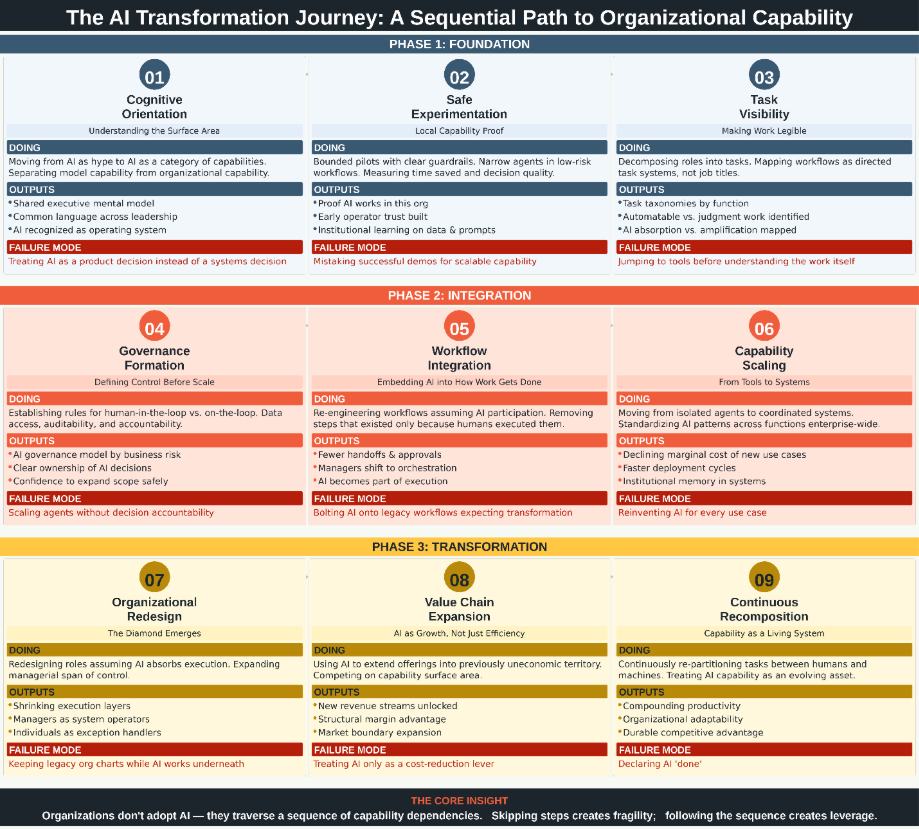
Graphic: Property of BIP Capital, LLC, All Rights Reserved
At BIP Capital, we have built the rubric above to help us plan for our own AI Transformation. We are making advances in all phases and sub-phases of the transformation journey, but we find that if we run too far ahead into the latter phases, we inevitably have breakdowns in quality and in our ability to transform the entire organization. Members of our Leadership Team have moved swiftly through the Foundation Phase and have integrated AI into all functions and processes of the organization. Other leaders continue to orient themselves to the possibilities of AI and how it will apply in their specific functional area. For perspective, it took the Early Adopters in our organization 2-3 months to get through the Foundation Phase. It takes time to learn the tools and capabilities of artificial intelligence, and those things are changing every day. We have now moved the entire organization into the Transformation Phase so we can begin to see the financial benefits of our actions.
Based on conversations with other business leaders and our portfolio companies, I believe companies are all over the place in their AI Journey. I would like to believe that BIP Capital and BIP Wealth are significantly ahead of most of the companies we compete with, based on the many conversations I have had in the last six months, but I am cut from the cloth of “only the paranoid survive.” So, I keep telling myself we are in a life-or-death race and we are behind.
I am also trying to impart the same philosophy to our portfolio companies. That is a mixed bag as well. A handful are racing forward and teaching me much more than I am teaching them. Most are in the early innings of their Transformation Journey. Some can’t seem to get started despite our constant encouragement to start preparing for an AI-First world.
Where Things Stand
Based on the data collected from conversations I have had in the last six months (N = ~150), I think it makes sense that we have not yet seen the traditional economic metrics move in a significant direction. Nobody is that far ahead yet (at least nobody I know). But I believe a great sorting is coming quicker than people realize based on our own journey and where some of the early adopters are trending.
It’s also not lost on me that many people will read this series of articles with differing concerns in mind. Some are worried about their investments. Others are worried about the companies they lead or work in. Some are worried about their careers. Others are worried about their kids’ ability to find jobs in the rapidly emerging business landscape. I can personally identify with each of those concerns.
When facing uncertainty, preparation for all eventualities has always been the best approach. So, I hope this series of articles serves as a framework and a catalyst for our investing partners, clients, employees, and friends to be prepared.
Because this time…I really think it is different.
